


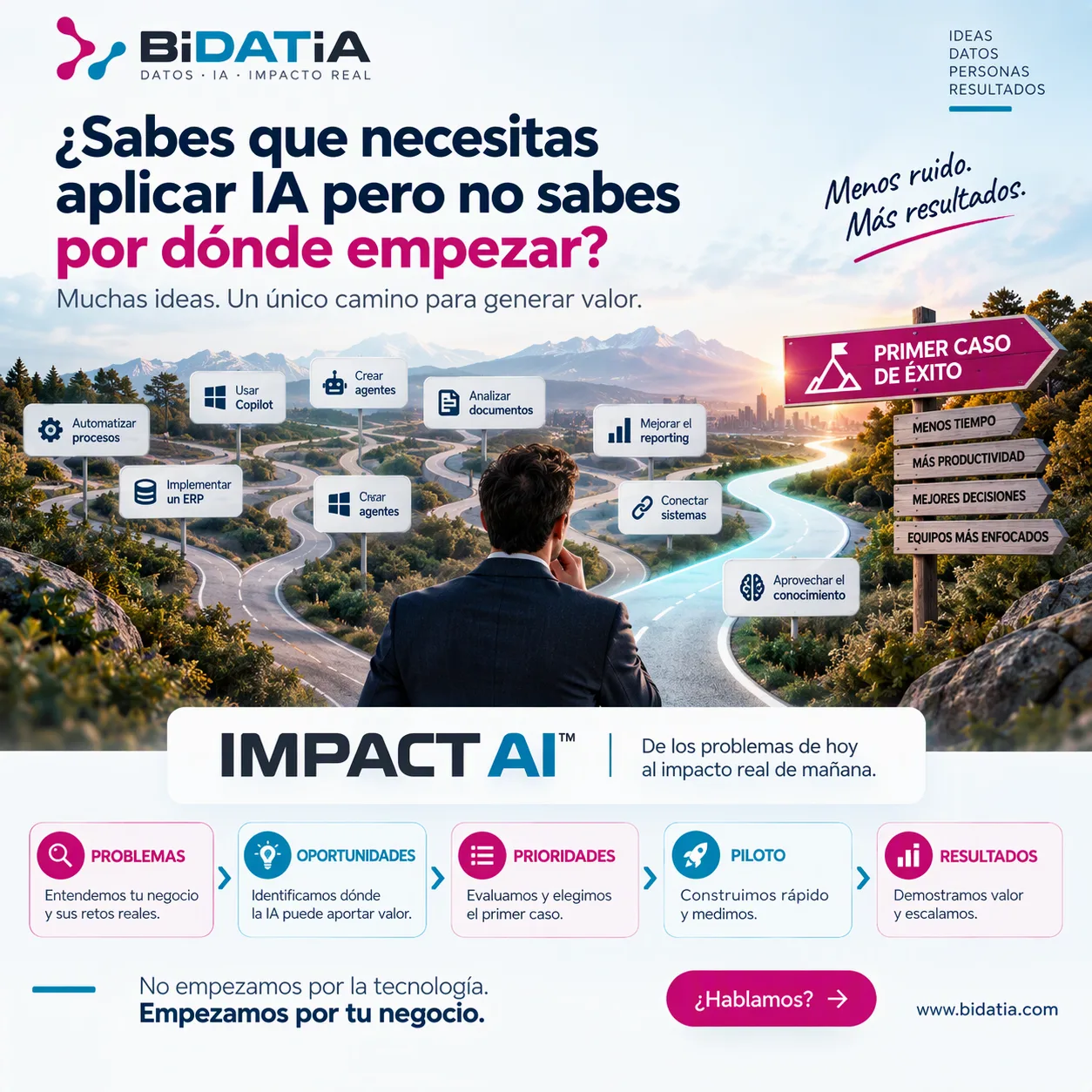
Most of the companies we talk to are no longer asking whether Artificial Intelligence will have an impact on their business. The question has changed: where do we start?
The possibilities seem endless: automating processes, deploying AI agents, analysing documents, improving reporting, using Copilot, connecting AI to the ERP, making the most of internal knowledge, helping the sales team or automating administrative tasks.
And that is precisely where one of the main problems arises: having many possibilities does not mean having an AI adoption strategy.
At Bidatia we believe the starting point should not be choosing a tool. It should be identifying a specific business problem, checking whether Data, AI and Automation can solve it and demonstrating their impact. That is where our IMPACT AI™ methodology comes from.
The mistake: starting by asking which AI tool we need
It is a conversation we hear more and more often:
- Should we roll out Microsoft Copilot?
- Should we build an agent?
- Should we use ChatGPT?
- Should we automate processes?
- Should we develop a RAG on our documentation?
These are all legitimate questions, but they are probably not the first ones we should be asking. I would ask first:
- Where are our teams losing time?
- Which processes generate the most manual tasks?
- Where are we repeating the same work?
- What information do we have to look for constantly?
- Where do we have errors or delays?
- What information do we move manually between applications?
- Which decisions would improve if we had better data?
- What knowledge do we hold in documents, systems or people that is difficult to make use of?
When we answer these questions, real Artificial Intelligence use cases start to emerge.
Where to look for AI opportunities?
There is no need to start with a particular sector. In our experience, it is more useful to analyse cross-cutting business processes and problems.
1. Sales processes
Sales teams spend a significant part of their time on tasks surrounding the sale:
- looking for information;
- preparing meetings;
- reviewing previous interactions;
- drawing up proposals;
- finding references;
- updating the CRM;
- summarising meetings;
- preparing follow-ups.
The opportunity does not necessarily lie in replacing the salesperson with an agent. It may simply consist of giving the sales team more time back to talk to customers, understand their needs and sell.
2. Document management
Many organisations still receive and process large volumes of contracts, invoices, tender specifications, orders, forms, applications, technical documentation, reports and case files.
Today's AI models can interpret unstructured information and combine it with traditional automation. But the question remains the same: what happens before and after the AI reads the document?
A good project should not end when the model extracts the information. The process must continue until it produces an action or outcome.
3. Operations and incidents
There is a very common phenomenon in companies: people acting as integrators between systems.
- An email arrives.
- Someone interprets it.
- They look up information in the ERP.
- They check a document.
- They copy information into Excel.
- They update another application.
- They reply.
- And afterwards they have to remember to follow up.
In these scenarios, the solution will not usually be Artificial Intelligence alone. It will be a combination of Process + Data + Integration + Automation + AI:
- AI can understand and classify.
- Automation can execute.
- Integrations can connect.
- Data provides context.
- And people retain judgement and control where they are genuinely needed.
4. Corporate knowledge
Another common problem is that a company has a great deal of information, but accessing knowledge is still difficult. Some of it is in SharePoint, some in an ERP, some in documents, some in departmental applications. And a particularly important part still resides in people.
Generative AI makes it possible to build new experiences for consulting and using that knowledge, but first we must resolve some fundamental questions:
- what information the system can use;
- who can access it;
- which source takes priority;
- how we ensure it is kept up to date;
- how we maintain permissions;
- how we know where an answer comes from.
Here, data quality and data governance stop being purely technological matters. They become prerequisites for using AI with confidence.
Not every problem needs Artificial Intelligence
This is one of the ideas we consider fundamental: we do not try to apply AI to everything.
- One process may simply need redesigning.
- Another may be solved with rule-based automation.
- Another will need two applications to be integrated.
- Another may first have a data quality problem.
- And there will be others where traditional or generative AI techniques will make a significant difference.
That is why our question is not «where can we use AI?». We prefer to ask: what problem do we want to solve and what technology do we need to solve it? It may seem like a small difference, but it completely changes the approach to a project.
So, how do you choose the first AI use case?
Once the opportunities have been identified, the next problem arises. Suppose we find 15 possible cases: which one do we tackle first? At Bidatia we propose analysing them using at least six dimensions:
| Dimension | What we ask ourselves |
|---|---|
| Business impact | What do we expect to improve? Time, costs, sales, productivity, quality, service, errors or capacity. |
| Feasibility | Can we reasonably build it with the technology available? |
| Data | Do we have the information we need? Can we access it? Is it of sufficient quality? |
| Effort | How much work does it take to go from a demonstration to a genuinely usable solution? |
| Risk | What happens if the AI gets it wrong? How much human oversight do we need? |
| Time to value | How long do we need to check whether the hypothesis works? |
The best first AI use case is rarely the most spectacular
This criterion is particularly important. Let us imagine two possibilities.
Case A. Extraordinary transformation potential. But it needs data from five systems, multiple integrations, process changes, complex security and six months of implementation.
Case B. Moderate-to-high potential impact. But we have the data, the process is identified, there is a business owner, we can build a pilot quickly and we can clearly measure the result.
To get started, we would probably choose case B. Why? Because a first case that works does much more than deliver ROI:
- It builds confidence.
- It enables learning.
- It uncovers data problems.
- It helps to understand security and governance needs.
- It trains people.
- And it makes it easier to tackle the next case.
IMPACT AI™: from opportunity to result
It is precisely to systematise this journey that we at Bidatia have developed our IMPACT AI™ methodology. We do not see it as a course on Artificial Intelligence, nor as a collection of tool demonstrations. It is a methodology for taking an organisation from problems and opportunities to AI use cases capable of demonstrating impact.
- Understand. We start with the business: objectives, problems, processes, people and priorities.
- Identify. We analyse where Data, Artificial Intelligence and Automation can deliver improvements.
- Prioritise. We assess the opportunities by impact, feasibility, data, effort, risk and speed of results.
- Design. We define the case: how it will work, what data it needs, which systems are involved, what the technology must do and where people must remain.
- Pilot. We build a first version that is representative enough to validate the hypothesis. The aim is not merely to produce a technically attractive demo: it is to check whether we are solving the problem.
- Measure. We define indicators from the outset: time saved, error reduction, cost, productivity, response times, quality, capacity freed up, conversion or other KPI related to the case.
- Scale. If the result works, we evolve the pilot into an integrated, secure and governed solution. And we look for the next case.
From AI projects to an ongoing capability for transformation
The ultimate goal should not be to have an Artificial Intelligence project. It should be to develop the organisation's capability to repeat this cycle:
Problem → Opportunity → Priority → Pilot → Measurement → Scale
Once this dynamic is working, AI adoption no longer depends on isolated initiatives and gradually becomes a business capability. And this is where other elements become even more important: reliable data, governance, integration, security, well-prepared people and suitable processes.
Because the greater the use of AI, the greater the need to control what information it works on, who can use it and how it is integrated into the organisation.
Is your company ready to start?
You do not need to have decided which AI model to use, or even to know yet whether you need an agent, Copilot, automation or bespoke development. You can start by answering five questions:
- Which task currently takes up too many hours?
- Which process generates the most manual work or errors?
- What information do we need constantly that is hard to find?
- Where do we have people transferring information between systems?
- Which decision could we improve if we had better data?
If clear answers emerge, you probably already have your first candidates for applying AI.
Our approach at Bidatia is precisely to start there. Not by asking which technology we should implement, but which problem is worth solving, and then finding the right combination of Data + Artificial Intelligence + Automation to do it.
IMPACT AI™: start by demonstrating value
If your organisation knows it needs to make progress with Artificial Intelligence but is not yet clear on where to start, which cases to prioritise or how to move from an idea to a first result, IMPACT AI™ is designed precisely to take you along that path:
Understand → Identify → Prioritise → Design → Pilot → Measure → Scale
We do not start with the technology. We start with your business.
Frequently asked questions
Where do I start applying AI in my business?
With a specific business problem, not a tool: where time is being lost, which processes generate manual tasks, what information is hard to find or where people are moving data between systems.
How do I choose the first AI use case?
By assessing each candidate on business impact, feasibility, available data, effort, risk and time to value. A case with available data, a business owner and a measurable result is usually the best choice.
Do all problems need artificial intelligence?
No. Some are solved by redesigning the process, with rule-based automation, by integrating applications or by improving data quality first.
Do I need to decide beforehand whether I want an agent, Copilot or bespoke development?
No. That decision comes after identifying the problem and designing the case; first you define what needs to be solved.