


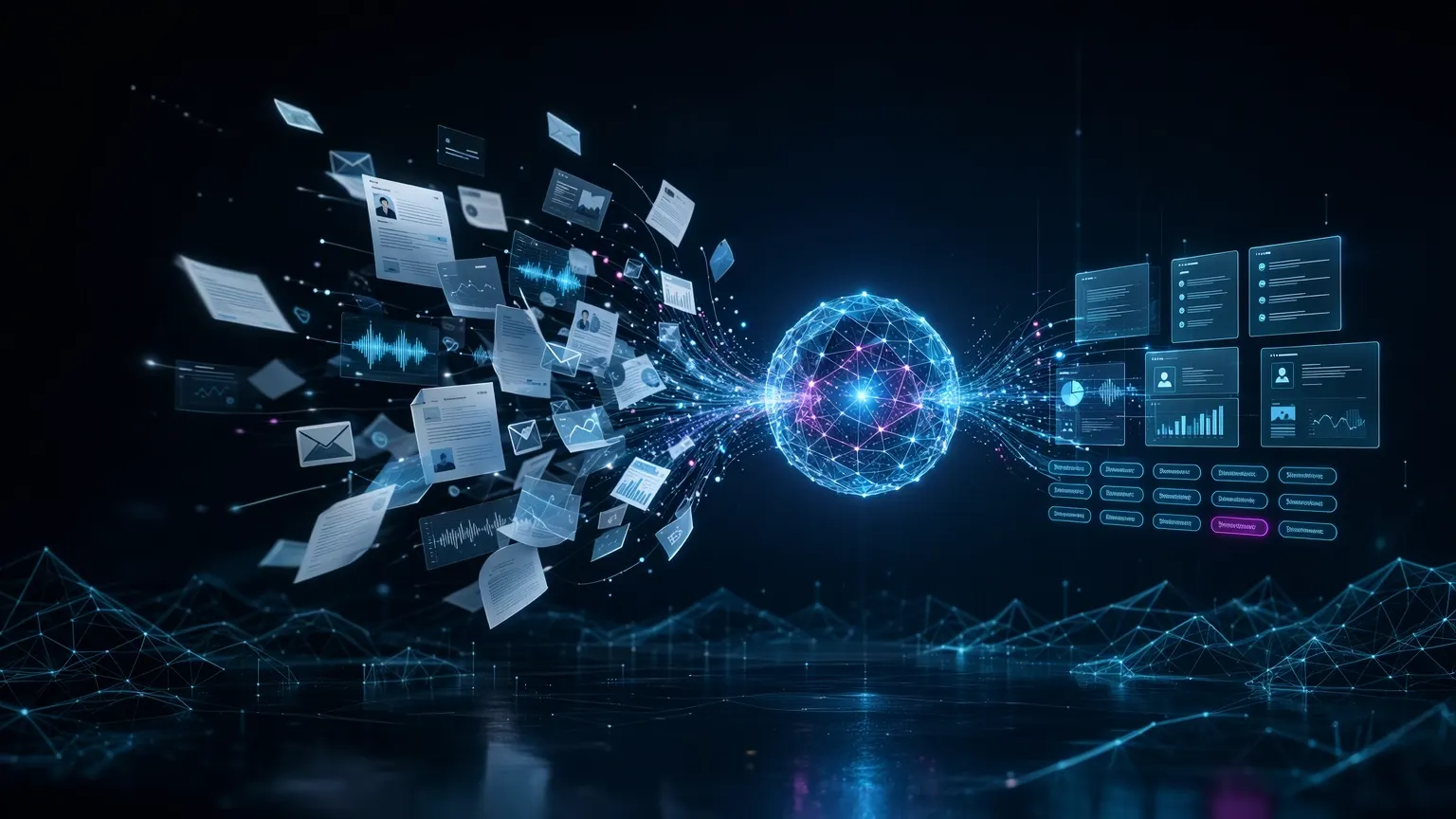
Business decisions rely mostly on structured data: sales tables, orders, invoices. Yet much of what an organisation knows lives elsewhere: call recordings, PDF contracts, emails, meeting minutes, customer comments on social media. In practice, that unstructured content is invisible to automation: no report summarises it and no process reacts to what it says.
What is missing to make use of it is metadata: specific fields that describe the content and that a system can actually use. "Customer intent", "reason for leaving", "non-standard penalty clause". Until now, creating that metadata meant someone reading or listening to every item, which is slow, expensive and impossible to scale. Generative AI agents change that equation.
The problem: metadata that cannot be created by hand
| Source | What it contains | Metadata of interest |
|---|---|---|
| Customer service transcripts | Complaints, questions, intent to buy or cancel | Reason for contact, frustration level, churn risk |
| Contracts and legal documents | Clauses, deadlines, obligations | Clause type, deviation from the organisation's template, risk level |
| Emails and tickets | Requests and incidents | Category, urgency, responsible team |
| Minutes and technical reports | Decisions and commitments | Agreements, owners, deadlines, discrepancies |
| Undocumented tables in the data platform | Columns with cryptic names | Purpose of the column, process that feeds it, likely owner |
When metadata creation does not scale, the business reacts late: the sign that a customer was about to leave was in last week's call, and the risk in the contract was on page 14.
What a generative AI agent is (and is not)
An agent is not a chatbot. It is a system that turns a business task into a sequence of actions and carries it out end to end. Powered by a language model, an agent can:
- Reason and plan: break the task down into logical steps.
- Act: use tools and APIs from business systems such as the CRM, the ERP or the document management system.
- Iterate: review intermediate results and adjust the plan.
The practical difference is clear. A chatbot replies "this call looks like a billing complaint". An agent analyses every recording from the week, extracts the defined fields, updates the CRM and records which passage each value is based on.
The technical stack has two layers:
- The model (the brain): a language model with reasoning capability and, where needed, multimodal support for audio and images.
- Orchestration (the body): platforms such as LangChain or n8n, or equivalent services from the major cloud providers, which define the workflow and connect the agent to the target systems.
RAG: accuracy with your own information
A language model does not know an organisation's contracts, policies or procedures, and if asked about them it may invent a plausible answer. The technique that solves this is retrieval-augmented generation (RAG):
- Query. The agent receives a specific task: "find the indemnity clause in this contract".
- Retrieval. The system searches the organisation's knowledge base for relevant passages: documents, databases, the data lake.
- Augmentation. The model receives the request together with those passages.
- Generation. The model returns the answer or the structured metadata, citing the internal sources it relies on.
RAG has become the reference approach for using generative AI with proprietary information: it keeps data under the organisation's control, avoids relying on what the model learnt during training and makes every result verifiable. It does not eliminate errors, but it makes them detectable.
Four high-value use cases
1. Customer service and sales
From transcripts, the agent extracts fields such as reason for contact, frustration level on a defined scale, reason for cancellation or lead qualification. With those fields in the CRM, customers at risk of churning can be spotted in time and team training can draw on real cases.
2. Procurement and legal
Working on PDF contracts, the agent identifies clauses, classifies them and flags deviations from the organisation's own template or risky clauses. Document reviews such as due diligence become much faster, and every finding is linked to the exact passage in the document thanks to RAG.
3. Documenting the data platform
Many tables in a data lake or warehouse have no documentation. An agent can propose the purpose of each column, the business process that feeds it and a likely owner, based on the schema, the load code and whatever documentation exists. These are proposals for the data steward to validate, but they remove the most tedious part of the work and speed up both the catalogue and GDPR compliance.
4. Analysing several sources at once
The agent compares, for example, a technical report, the applicable regulations and the notes from a meeting, and extracts key differences and potential non-compliance. A person can do this, but not across dozens of documents at once, nor every time one of them changes.
How to ensure metadata quality
Metadata that nobody trusts is useless. A few practices make the difference:
- A closed schema. Define the fields and their permitted values in advance (controlled lists, scales) and require the model to return exactly that format.
- Cited source. Each value carries a reference to the source passage, so review is quick.
- A validated sample. Measure accuracy against a set reviewed by experts before automating, and repeat the measurement periodically.
- Human review in proportion to risk. Systematic validation for legal matters or anything affecting people's rights; sampling for operational ones.
- Personal data under control. Transcripts and emails contain personal data: minimise what is sent to the model and control where it is processed and who sees the results.
Adoption roadmap
| Phase | Focus | Who is involved |
|---|---|---|
| 1. Discovery | Prove value in a low-risk use case, for example classifying a batch of documents | Innovation and the business area concerned |
| 2. Industrialising RAG | Build the secure knowledge base and a RAG architecture with traceability | Data architecture, security |
| 3. Pilot agents | Deploy agents in the priority use cases and measure efficiency and quality indicators | Business, data, security |
| 4. Scale | Embed agents in end-to-end processes, with more autonomy, auditing and AI governance | The whole organisation, within a stable governance framework |
Each phase should close with measured results (accuracy, time saved, adoption) before moving on to the next.
Where to start
The useful question is not "what can we do with AI?" but "which metadata are we missing, and what is it worth to have it?". A good starting point is to choose that metadata in the area where it hurts most (usually customer service or contracts), define its schema, prepare a validated sample and build a proof of concept that measures accuracy on real data. At Bidatia we support this kind of project, from choosing the use case to integrating it with the data platform and data governance.
Frequently asked questions
What is AI-extracted metadata?
A structured data point that an agent obtains by reading unstructured content: for example, the reason for a call taken from its transcript, or the type of penalty in a contract taken from the PDF. It is stored in a specific field in the CRM, document management system or data catalogue, with a reference to the source.
Does RAG eliminate hallucinations?
It does not eliminate them, but it reduces them considerably, because the model answers from passages retrieved from the organisation's sources and can cite them. For metadata with consequences, such as the risk level of a clause, keep a human review step and measure accuracy against a validated sample.
Which use case should we start with?
A low-risk one with enough documents and an outcome that is easy to check: classifying a batch of documents by type, or extracting a few fields from a set of contracts. It lets you measure quality before touching critical processes.
What about personal data in recordings and emails?
Transcripts and emails usually contain personal data, sometimes sensitive. Before processing them, review the lawful basis, minimise what is sent to the model, control where it is processed and who can see the results, and consider whether a data protection impact assessment is needed.