

Defining a technological strategy is just the first step for any organization. The real challenge arises when it's time to execute it. Without a Data operating model Of course, companies encounter duplication, power vacuums, and total paralysis when it comes to making strategic decisions based on real information.
To structure this chaos, experts base their work on two pillars: the international framework LADY DMBOK and the responsibility matrix RACI.
The DAMA DMBOK Framework: The Roadmap
Imagine you want to build a city from scratch. You wouldn't start laying bricks without a master plan, would you? DAMA DMBOK (Data Management Body of Knowledgeis that urban plan for your data.
This international standard tells us that Data Governance is not an island, but must connect with:
- Data Architecture How are systems structured?.
- Security How we protect private information.
- Operations: How do we save and retrieve the data daily.
Without this framework, each department would try to «build its own house» without looking at its neighbor, resulting in a completely disorganized city (or company).
The importance of the RACI matrix in the data operating model
As expert Carlos Olivera rightly points out, the Operating Model is what allows the strategy to land in day-to-day reality. It's not enough to say «we're going to govern data»; you have to define the workflows. And this is where the RACI Matrix becomes indispensable.
RACI is an acronym that defines four fundamental roles for each task or process:
- Responsible It's the one who «breaks rocks.» The one who executes the technical or administrative task.
- Accountable (Authority/Accountable person): He/She is the owner of the process. There can only be one per task. If something goes wrong, he/she is the one accountable; if it goes well, he/she is the one who signs off on the success.
- Consulted Experts or areas that provide valuable information. They do not execute, but their opinion is necessary before moving forward.
- Informed People who need to know the progress or outcome but are not involved in the execution or decision-making.
Example: Data Governance in a Banking Environment
To understand how the RACI model avoids conflict, let's look at a critical process: The approval of a new customer segmentation model for mortgages.
- Responsible (R): The Data Science Team. They are the ones who program the algorithm, clean the data, and run the technical tests. They are the ones who «do» the work.
- Accountable The Chief Data Officer or the Mortgage Business Owner. He doesn't program the algorithm, but he is the one who gives the final «okay.» If the model fails and the bank loses money, the ultimate responsibility is his. His role is to ensure the process meets the company's objectives.
- Consulted (C): The Legal and Compliance Department. Before activating the model, the Data Science team asks: «Can we use the ‘marital status’ data for this calculation according to current law?». Legal provides its expert knowledge so that the project does not start with legal issues.
- Informed (I): The Bank Branch Managers.They do not decide how the model works nor do they program it, but they must be informed that, starting Monday, the system will classify customers in a new way so they can explain it to end-users.
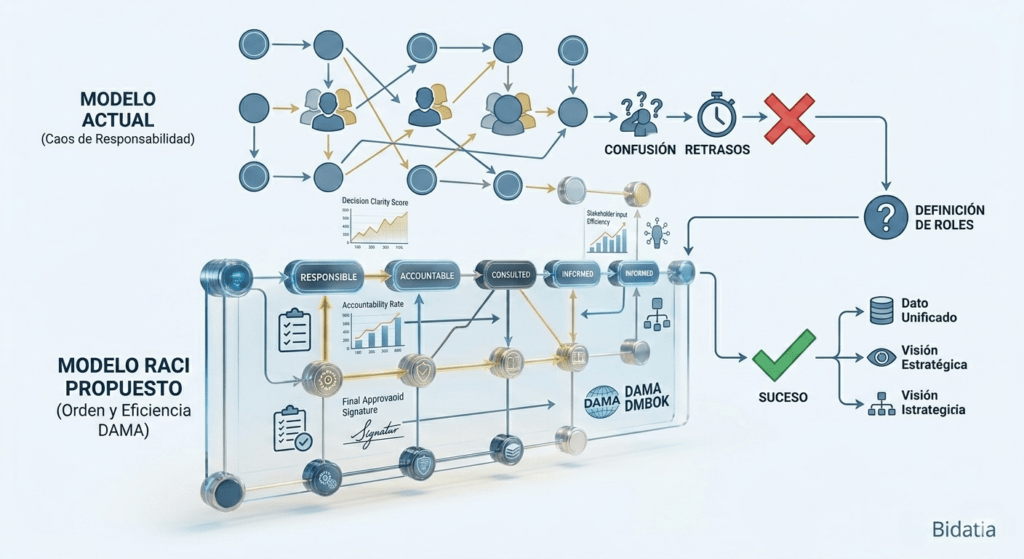
Why does the model fail if there's no clear RACI?
Following Carlos Olivera's vision, a common mistake is assigning tasks without defining the «Accountable.» When everyone is responsible, no one is responsible.
Without a Data operating model well structured
- Decisions are taking forever: No one knows who has the final say.
- Duplication of efforts Two departments clean the same data in different ways.
- Security breaches It is assumed that «someone» is controlling access when in reality no one has been assigned to do it.
Conclusion: People first, technology second
Data Governance is, above all, a cultural change. Adopting models like RACI and frameworks like DAMA DMBOK allows technology to work for people, and not the other way around. Only when each member of the organization understands their role in the data value chain does information begin to generate real profitability.
Do you need to define data roles in your organization?
At Bidatia We help you design your own Data operating model through personalized consulting that eliminates confusion and accelerates your company's digital transformation.