

In today's business landscape, the real challenge of Data Governance is not just registering where the information is. On the contrary, the challenge is to be able to protect it, classify it, and measure its quality in real time. When organizations manage complex hybrid environments, the implementation of IBM Knowledge Catalog (IKC) positions itself as the industry standard. This suite stands out for its Artificial Intelligence engine capable of discovering and enriching data assets at scale.
At Bidatia We approach IBM Knowledge Catalog deployments with a purely engineering focus. In this guide, we detail the critical aspects of its Containerized architecture, automated data discovery and his extensibility through APIs.
1. Architecture and Requirements for Implementing IBM Knowledge Catalog
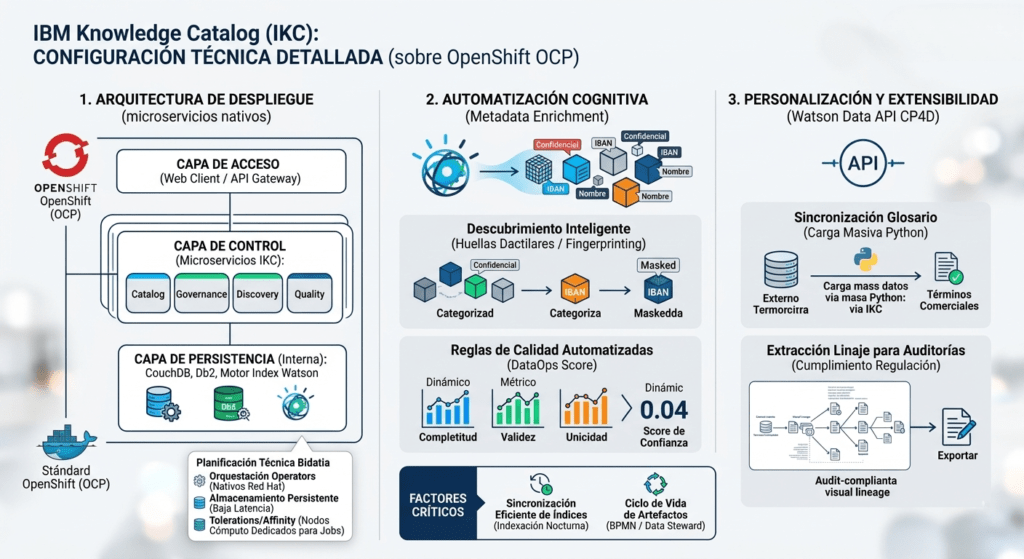
IBM Knowledge Catalog operates as a cloud-native microservice within the IBM Cloud Pak for Data architecture. Its deployment is standardized on Red Hat OpenShift Container Platform (OCP), which guarantees absolute portability and hyper-scalability.
The infrastructure is organized into three main layers:
- Access Cover User interface via the Cloud Pak for Data web client and API Gateway.
- Control Plane (OpenShift Cluster): IKC internal microservices dedicated to cataloging, governance, and discovery tasksCatalog, Governance, Discovery).
- Persistence Layer Internal databases for the storage of operational data and metadata (CouchDB and Db2 OLTP) alongside the Watson indexing engine.
At Bidatia We plan the technical provisioning of IKC under two key guidelines to ensure production performance:
Orchestration and persistent storage
We deployed IKC using Operators Red Hat natives. First of all, we configure container resource requests. Secondly, we assign low-latency persistent storage such as IBM Spectrum Scale. As a result, we ensure CouchDB and Db2 maintain the necessary IOPS performance for massive metadata streams.
Pod Isolation and Scaling
To prevent heavy analysis processes from degrading the business user experience, we configured affinity and tolerance rulesTolerations/Affinity) in OpenShift. Thus, we force the pods responsible for automatic discovery (Data Discovery JobsTo run exclusively on dedicated compute nodes.
2. Quality Automation and Cognitive Discovery
The great differentiating element of IKC is the Metadata Enrichment. Instead of manually cataloging, we configured the IBM machine learning engine to automate data governance at scale.
Smart Discovery using Data Fingerprinting
Configuring manual rules using regular expressions is a thing of the past. In Bidatia We train the IKC classification models using data fingerprint matching algorithmsData Fingerprinting).
This allows the system to analyze the actual content of a column and determine with a high percentage of confidence whether it is an IBAN code, a customer identifier, or confidential information. From here, the catalog applies Data Protection Rules in an automated way to mask or obfuscate sensitive data in real time according to the role of the user making the query.
Automated quality rules in the style of DataOps
We aligned the platform with DataOps methodologies by configuring quality rules (Data Quality Rules. These continuously evaluate critical dimensions such as data completeness, validity, and uniqueness, generating a score dynamic and reliable for each dataset visible in the catalog.
3. Customization and extensibility via the Cloud Pak for Data API
To integrate IBM Knowledge Catalog with the rest of the company's development ecosystem (CI/CD pipelines, corporate ticketing systems, or internal portals), we consume the powerful Cloud Pak for Data REST API (Watson Data API).
Through this integration architecture, we automate two critical processes:
- Programmatic Glossary Synchronization: We develop automated connectors in Python that perform secure calls to the endpoints IKC governance. This allows for the mass registration and updating of new business terms approved by data committees from any centralized external repository, completely eliminating manual effort on the web interface.
- Lineage Extraction for Regulated Audits: For companies in highly regulated sectors (like banking or healthcare) facing strict regulatory audits, we use the IKC API to extract technical lineage graphs in bulk. This data is directly connected to global compliance dashboards or exported into standard audit formats.
Critical Success Factors: Bidatia's Experience
Given the robustness and dimensions of the Cloud Pak for Data suite, we base our implementations on two golden engineering rules:
- Efficient Index Synchronization: We've configured the Watson-based search engine to ensure that nightly reindexing tasks run optimally and don't conflict with business analysts' peak hours.
- Artifact Lifecycle with Workflows: We implement custom approval workflows using IKC's built-in BPMN engine. This ensures that any change to a quality rule or glossary term goes through mandatory validation by the Data Steward assigned before impacting production environments.
Conclusion: Successful implementation of IBM Knowledge Catalog
This platform is the ultimate solution for organizations seeking intelligent, automated data governance tailored to architectures. cloud hybrids. Therefore, it is not a simple inventory, but a cognitive ecosystem.
At Bidatia We have the expertise in OpenShift and data engineering to ensure that your deployment runs smoothly and is fully aligned with your goals