In previous articles, we looked at what Data Governance is and how to organize people to manage it. But, How to know if it's really working? In the business world, what isn't measured cannot be improved.
The data quality metrics they are not an opinion; they represent a science governed by specific standards and dimensions. If your company makes decisions based on low-quality data, it's building its future on shaky ground.
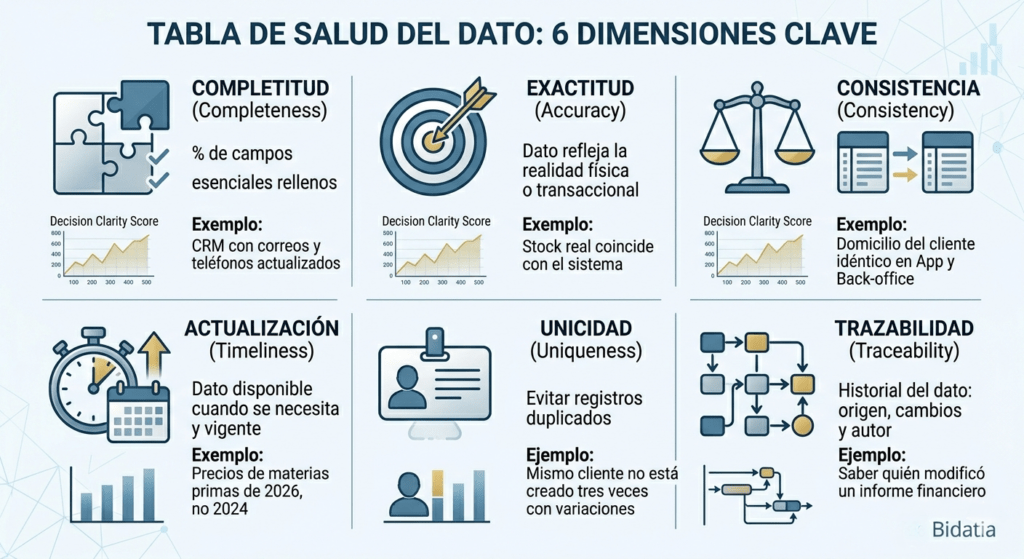
The 6 Dimensions of Data Quality Metrics
For information to be useful, it must meet minimum standards. Let's break down the key dimensions with examples to understand how they affect an organization's day-to-day operations.
Completeness: Do we have the whole picture?
Completeness measures if the essential fields of your database are filled.
Example: Imagine a City Hall that wants to digitize its administrative procedures. If the 40% records in the citizen database do not include an email address or a cell phone number, the «completeness» is low. As a result, nearly half the population will not receive important notifications, forcing the City Council to spend money on physical letters and in-person customer service staff.
2. Accuracy: Does the data reflect reality?
A piece of data can be well-written but false. Accuracy assesses whether the information matches physical or transactional reality.
Example: In one. Logistics company, The system indicates there are 500 units of a product in «Warehouse A.» However, when the operator goes to retrieve them, there are only 400 because there were unregistered breakages. The data is consistent in the software, but it is not accurate. This causes delivery delays and loss of customer trust.
3. Consistency: The End of Contradictions
Consistency ensures that data is the same, regardless of the system we consult.
Example: In a Bank, a customer changes their address in the mobile app. If the «Credit Cards» system is not updated and continues to send plastic cards to the old address, there is a lack of consistency. The customer appears with two different realities within the same company.
4. Timeliness: Did we arrive on time?
Information has an expiration date. Data that was accurate two years ago can be a burden today.
Example: One Manufacturing company Analyze commodity prices to calculate their 2026 budgets. If you use 2024 prices because the system has not been updated, the budget will be dead on arrival, and the company will lose money on every sale.
5. Uniqueness (Avoiding Duplicates)
This is the most common error: having the same client or supplier created multiple times with slight variations (e.g., «Juan Perez» and «J. Perez»).
Example: A hotel chain has the same customer duplicated three times because they booked through different platforms. The system thinks it has three new customers when in reality it has a single, very loyal customer. Not knowing it's the same person, the hotel misses the opportunity to offer them preferential treatment (loyalty rewards) for their multiple visits.
6. Traceability: The Data's History
Traceability allows us to know where data comes from, who touched it, and what changes it underwent. It is vital for audits and security.
The Impact on Artificial Intelligence: «Garbage In, Garbage Out»
There's a golden rule in technology: Garbage in, garbage out.
If you're trying to train an AI to predict your store's stock, but your inventory data isn't exact and your sales records aren't consistent, AI will give you wrong predictions. Data Governance and its data quality metrics they are the filter that ensures only «clean information» reaches your algorithms.
How to start measuring the health of your information?
To implement these data quality metrics, organizations often use Quality Dashboards. Instead of just looking at sales, managers are starting to monitor technical KPIs such as:
- % of duplicate records in the CRM.
- Average update time from the supplier data.
- Error rate in the monthly financial reports.
Conclusion: Data as a compass, not an anchor
Investing in data quality is not an expense; it's business life insurance. An organization that knows and cares for the health of its information can confidently automate processes, reduce operating costs, and, above all, make decisions with the certainty of someone standing on solid ground.
Do you want to know the data health level in your company?
At Bidatia we perform quality audits and define the data quality metrics necessary for your information to become the engine of your growth.