
Data has become organizations' most valuable asset, especially with the rise of corporate Artificial Intelligence. In this scenario, analyzing and comparing the best data governance tools it's an absolute priority. As we often say in Bidatia, If you can't trust the origin and quality of your figures, your analyses and your AI models are just high-stakes guesswork.
To implement a strategy Data Governance solid, organizations need tools that not only manage traditional data but also cover AI Governance. This involves mapping the inventory of models, ensuring algorithm explainability, and mitigating regulatory biases.
What should a Chief Data Officer demand and compare in 2026?
The role of Chief Data Officer It has evolved. It's no longer enough to ensure that data is stored securely; you now need to guarantee that the data is available, democratized, and ready for business and cognitive system consumption.
When evaluating a platform, a CDO should prioritize:
- Interoperability That it connects natively to hybrid and multi-cloud ecosystems without generating vendor lock-in.
- AI Automation That the tool itself uses AI for intelligent metadata tagging and anomaly detection.
- Automatic regulatory support Capacity to natively audit compliance with regulations such as the GDPR or the EU AI Act.
DAMA Framework Government Requirements Matrix
To ensure the technological choice covers all areas of knowledge of the international framework DAMA (Data Management Association), we evaluate the platforms under this matrix of essential requirements:
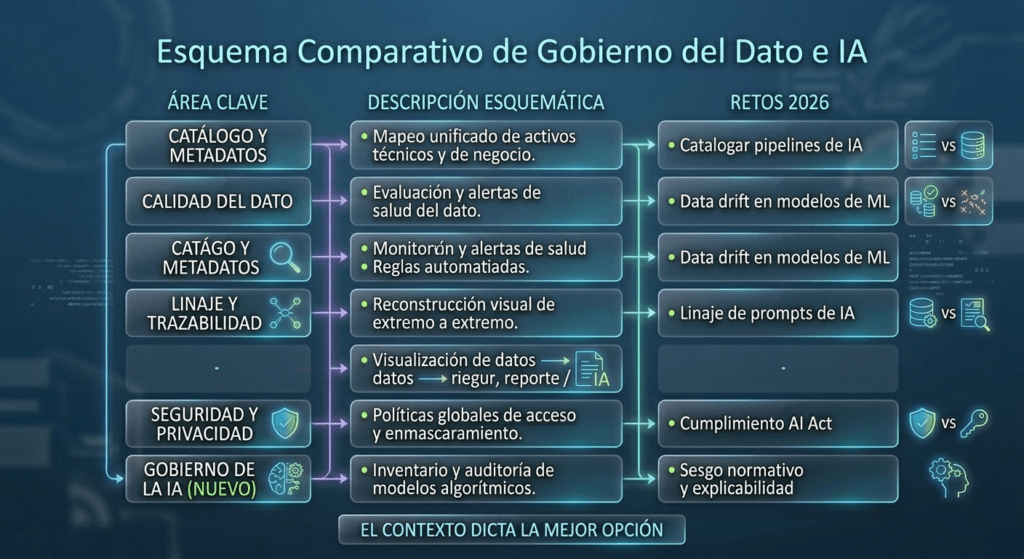
| DAMA Area / Requirement | Critical Coverage Description | Key Functionality to Require |
| Catalog and Metadata | Automatic indexing of technical and business information assets. | Unified Business Glossary and Semantic Search. |
| Data Quality | Data health assessment, measurement, and monitoring. | Automated quality rules and alerts data drift. |
| Lineage and Traceability | Visual reconstruction of the end-to-end data lifecycle. | Data Lineage bidirectional from source to report/AI. |
| Security and Privacy | Access control and sensitive data masking. | Role-Based Access Control (RBAC) Global Policies. |
| Integration and Architecture | Ability to operate in modern architectures like Data Mesh. | Native connectors via APIs and support multi-cloud. |
| Data Marketplace | Self-service space where businesses securely buy/consume data. | Shopping cart for datasets with automated approvals. |
| AI Government | Inventory, audit, and traceability of analytical models. | Algorithm registry, prompt lineage, and training data. |
Analysis of the best leading data governance tools
Each of these tools stands out as an outstanding solution depending on the organization's infrastructure, business fabric, and digital maturity.
Microsoft Purview
If your organization already works with the Azure environment or is unifying its analytics with Microsoft Fabric,Purview is an extraordinarily natural option.
- Strengths: It stands out for its automated mapping and seamless, native integration with Power BI and Microsoft 365.
- AI Coverage: It integrates seamlessly with the Azure OpenAI ecosystem, allowing you to automatically classify and protect the data that feeds your enterprise copilots.
- Ideal for: Companies strongly linked to the Microsoft ecosystem seeking agile and centralized deployment.
2. Informatica Data Management Cloud (IDMC)
Informatica continues to be one of the historical and most technologically robust pillars for large-scale, complex environments.
- Strengths: Its extremely high scalability, its advanced deep data cleansing capabilities, and lineage management in highly complex environments.
- AI Coverage: Its artificial intelligence engine, CLAIRE, automates large-scale data discovery and offers native capabilities for governing training data and evaluating machine learning model performance.
- Ideal for: Large corporations with hybrid ecosystems, complex legacy architectures, and massive volumes of information.
3. Google Dataplex
Google Cloud's integrated proposal in its Modern Data Stack offers intelligent and unified data management.
- Strengths: Excellent data isolation automationdata isolation) integrated data quality, and unified policy control across distributed data lakes.
- AI Coverage: When natively connected with Vertex AI, allows for impeccable governance of the data lifecycle that trains language models (LLMs) and ensures lineage from ingestion to AI inference.
- Ideal for: Organizations with native architectures on Google Cloud or that heavily utilize BigQuery for advanced analytics.
4. Anjana Data
One of the data governance tools with national recognition that has earned enormous international prestige thanks to its disruptive approach focused on collaborative governance.
- Strengths: Its flexible, agnostic, and storage-independent architecture, along with an excellent user interface for business profiles and Data Stewards. It is magnificent for the implementation of architectures like Data Mesh.
- AI Coverage: Allows incorporating AI models as another data asset within your catalog, mapping their technical lineage, and integrating data ethics committees into approval workflows.
- Ideal for: Organizations seeking a flexible solution to implement a tailor-made governance model, with a strong emphasis on business glossary and custom workflows.
5. Erwin by Quest
A suite par excellence oriented towards strategic governance and the alignment between technology and business.
- Strengths: Its data modeling capabilities are the industry standard. It allows for the seamless blending of technical database language with the conceptual and strategic maps of executives.
- AI Coverage: Offers specific modeling frameworks for documenting AI system architecture, enabling rigorous compliance with algorithmic maturity audits.
- Ideal for: Companies in highly regulated sectors (banking, insurance, utilities) that prioritize strict regulatory compliance and alignment of business processes.
6. OpenMetadata
The open-source alternative that is transforming the sector with a modern and collaborative approach.
- Strengths: Its intuitive user interface in the style of modern corporate social networks. It is fully API-based (OpenAPI) and fosters native team collaboration through chats and alerts integrated within the datasets themselves.
- AI Coverage: It has native connectors for AI ecosystem tools and allows you to catalog and scoredata scoringdata pipelines for machine learning.
- Ideal for: Tech companies, scaling startups, or teams with a strong technical culture that prefer agile architectures based on open source.
Bidatia's advice: Context dictates the best option
As we have analyzed, there is no single «best tool» in absolute terms, but rather the optimal solution for the context, infrastructure, and maturity level from each organization. A large corporation with multicloud systems will find its best allies in Informatica or Google Dataplex; a unified corporate environment will maximize the potential of Microsoft Purview; while organizations seeking flexibility or a strong methodological and business focus will shine with Anjana Data or erwin.
No single tool will solve the lack of governance if it is not accompanied by the human factor. It is essential to define key roles (Data Owners y Data Stewards), design clear policies and outline a progressive adoption roadmap.
At Bidatia we help companies both take their first steps to become a Data-driven company how to optimize advanced architectures. We conduct maturity audits, design master data dictionaries, and implement technology platforms from leading market manufacturers, adapting them to your real needs.
What tool best fits into your current infrastructure?
Don't blindly choose your data governance tools. In Bidatia We analyze your technology stack and business objectives to recommend and implement the ideal solution.