In the era of Big Data, many organizations have fallen into a dangerous trap: believing that accumulating large volumes of information is equivalent to having power. The reality is much harsher. Without a clear strategy for data governance, Excess information doesn't generate knowledge, but rather noise, unnecessary costs, and wrong decisions.
This is where the Data Governance. It's not just a technical concept; it's the compass that allows companies and public administrations to transform the chaos of their files into a real strategic asset.
What is Data Governance Really? (And Why It's Not Just an «IT Thing»)
The mistake is often made of thinking that data governance is a one-time software installation and then you forget about it. Nothing could be further from the truth. Data governance is a Policy, Roles, and Processes Ecosystem designed to ensure that information is reliable, secure, and above all, useful. In fact, there are reference frameworks and UNE specifications for data management and quality that help organizations strictly evaluate whether they are following industry best practices.
Imagine your organization is a giant library. If the books aren't cataloged, if pages are torn out, or if anyone can enter and change the cover titles, the library loses its value. Data governance is the head librarian: it establishes who can enter, how the books are classified, and ensures that what the cover says matches the content.
The problems that Data Governance aims to solve
If you encounter any of these situations in your daily life, your organization urgently needs a governance strategy:
- Conflicting reports The sales department says money has been made, but the finance department says money has been lost.
- Duplicate data: The same client is registered five times with minimal variations in their name.
- Disconnected systems: The logistics software doesn't know what's going on in the customer service CRM.
The Danger of Information «Silos»: A Real-World Example
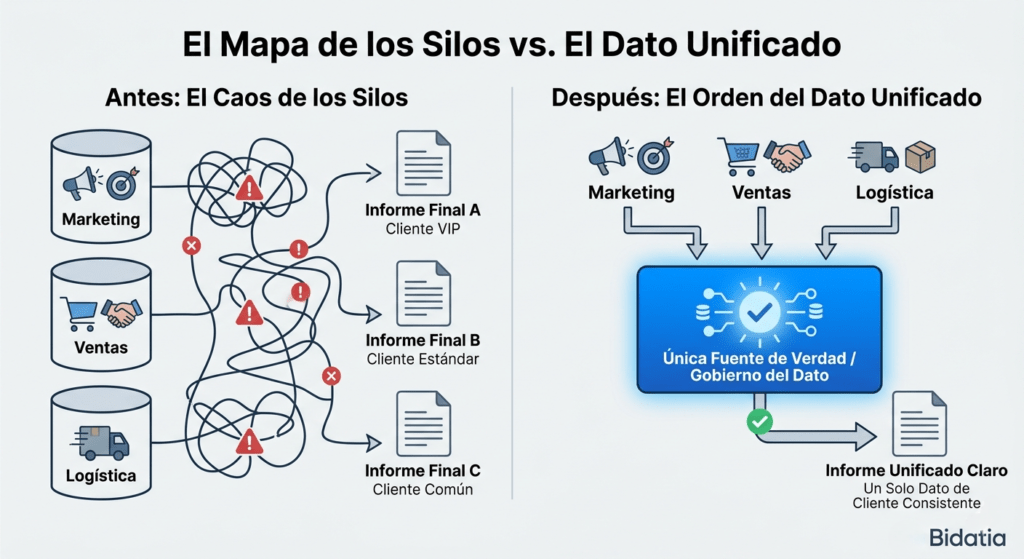
One of the greatest enemies of efficiency is the «silo.» This happens when each department keeps its information under lock and key with its own rules.
Let's use an extensive example in the retail sector:
Imagine a national fashion retail chain. The team Marketing launch an aggressive campaign to promote a specific jacket because their data shows it's the one that receives the most «clicks» on the web. At the same time, the team Logistics has data showing that this jacket has a return rate of 40% because it runs small.
Without data governance that unifies information, Marketing will continue to burn budget on a product that is sinking profitability due to returns. A governance strategy allows both departments to speak the same language, unifying the vision of product «success.».
The mandatory bridge to Artificial Intelligence
Today everyone wants to implement AI and automation. However, artificial intelligence is like a gourmet chef: no matter how good the chef is, if the ingredients are rotten, the dish will be a disaster.
AI is fed by data. If that data is incorrect or biased, the AI will make decisions that can severely harm your company. Therefore, Data Governance is not an optional step; it is the mandatory preparation for any technological innovation project. Before teaching a machine to think, we must teach it to read clean and truthful data.
Tangible Benefits: Beyond Theory
Implementing a data governance culture isn't just for «filing papers.» It has direct benefits to the bottom line:
- Better decision-making Executives are shifting from relying on «intuition» to relying on proven realities.
- Operational efficiency Less time is wasted searching for data or correcting manual errors.
- Regulatory Compliance Facilitates compliance with privacy laws like GDPR, avoiding hefty fines.
- Agility An organization with organized data can react to market changes much faster than one that lives in chaos.
Conclusion: From Competitive Advantage to Survival
In an environment where every click and every transaction generates information, having a solid data governance strategy is no longer a «nice-to-have.» It's a matter of survival. Organizations that master their data will master their future; those that don't will be buried by their own information.
Is your organization ready to take the step towards smart management?
At Bidatia We are specialists in helping companies and administrations organize their information so they can focus on what they do best: growing and serving their citizens.