

Many organizations have already accepted an undeniable reality: without a clear governance strategy, business reports lose value due to a lack of trust in the information. If you're wondering about how to deploy Microsoft Purview Pragmatically and without disrupting your company's daily operations, the key is not technology, but methodology.
Microsoft Purview has established itself as one of the most powerful and complete solutions for Data GovernanceData Governancein hybrid and multi-cloud environments. But its success depends on structured and progressive execution.
At Bidatia we often see a critical error: «We installed the tool in our cloud and then we decide what we govern.». This approach, focused exclusively on technology, often results in empty data catalogs, organizational confusion, and bureaucratic governance that no one uses. To avoid this, we apply a 5-Phase Deployment Framework oriented to providing real business value from the first weeks.
The 5-Phase Purview Deployment Framework
Our methodology is based on an incremental cycle that mitigates technical and financial risks, guaranteeing quick returns on investment.Quick Wins).
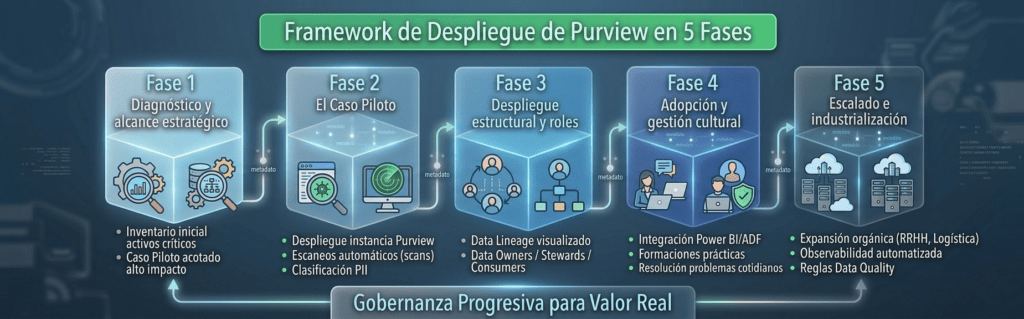
Phase 1: Diagnostic and strategic scope
Before enabling services in the Azure console, it is crucial to define the scope of the project. We conduct an initial inventory of your critical assets (data lakes, data warehouses, CRM, BI platforms) and select a a limited-scope but high-impact pilot project (for example: regulated financial reporting, customer master data, or the datasets that will feed a high-priority analytical model).
Phase 2: The Pilot Case (Rapid Value Generation)
We deployed the Microsoft Purview instance and configured the initial structure of Collections, representing your company's organizational hierarchy (Finance, Operations, Commercial). We connect the pilot's data sources and launch the first automated scans (scans) for Purview to discover schemas, identify data types, and automatically classify sensitive or personally identifiable information (PII).
Phase 3: Structural Deployment and Role Assignment
Pilot validated, we lay the formal foundations of corporate governance. We configure the Data Lineage (Data Lineage) to visualize the complete traceability of information from its technical origin to its final consumption in Power BI. Likewise, we map responsibilities across three key organizational profiles:
- Data Owners: Business owners who define the rules, criticality, and meaning of data.
- Data Stewards: Technical custodians responsible for documenting, validating, and ensuring the quality of metadata in Purview.
- Data Consumers: Analysts and business users who consult the catalog to exploit information with full confidence.
Phase 4: Adoption and management of cultural change
A data catalog that no one consults becomes a dead repository. In this phase, we integrate Purview into the team's daily work tools (Power BI or Azure Data Factory). We provide practical training focused on solving everyday problems for analysts, such as quickly locating certified datasets or performing impact analysis before modifying table structures.
Phase 5: Scaling and Automated Industrialization
With the foundation in place and the governance culture adopted by the teams, we organically expanded the framework to the rest of the company’s departments (Human Resources, Logistics, Supply Chain), automating observability workflows and advanced data quality rules (Data Quality).
Keys to Success for an Efficient Implementation
Based on our experience in corporate environments, the success of a Microsoft Purview deployment comes down to striking the right operational balance:
- What works: Start with a controlled scope, involve business unit leaders from the very beginning, document the project with clear business definitions, and measure success based on actual user adoption rates.
- What you should avoid: Treating the project as an exclusive IT department task, attempting to govern all company databases simultaneously, or designing bureaucratic approval flows that slow down the work of data scientists and engineers.
Conclusion: The Return of Corporate Governance
Implementing Microsoft Purview under a structured methodology provides tangible short-term returns (visibility and silo elimination), medium-term returns (maximum confidence in reports and executive summaries), and long-term returns, ensuring industrialized regulatory compliance and A clean, well-managed infrastructure, ready to deploy artificial intelligence without operational risks.
At Bidatia We apply this practical and progressive approach so that your investment in data governance translates into business efficiency from the very first weeks.