

In today's Data Governance market, many organizations find themselves caught between two extremes: traditional enterprise suites that are overly rigid, or open-source catalogs that lack the necessary business controls. To break free from this dilemma, the implementation of Anjana Data it has positioned itself as one of the most innovative solutions thanks to its agnostic approach, its microservices architecture, and its revolutionary dynamic and flexible metamodel.
Unlike tools that impose their own data structure, Anjana Data acts like an orchestra conductor that adapts to the organization, allowing for governance of environments On-premises and architectures multicloud in a unified way.
At Bidatia We approach Anjana Data's projects from the perspective of systems engineering and solution architecture. In this guide, we detail the fundamental aspects of its container-based deployment, its metamodel configuration and his event-driven integration.
1. Microservices Architecture and Deployment Strategy
Anjana Data is designed with a modern, decoupled microservices architecture, granting it high scalability and the ability to be deployed on any infrastructure. cloud (Azure, AWS, Google Cloud) or on-premises environments.
The suite is organized into the following technical layers:
- Presentation Cover User interface based on Anjana Portal (Angular) and API Gateway access gateways.
- Logic Layer (Microservices) Independent services dedicated to specific tasks (Core, Admin, Audit, Data-Discovery, Workflows).
- Persistence and Indexing Layer Relational storage (PostgreSQL), semantic indexing engine (Elasticsearch/OpenSearch), and an asynchronous messaging broker (RabbitMQ).
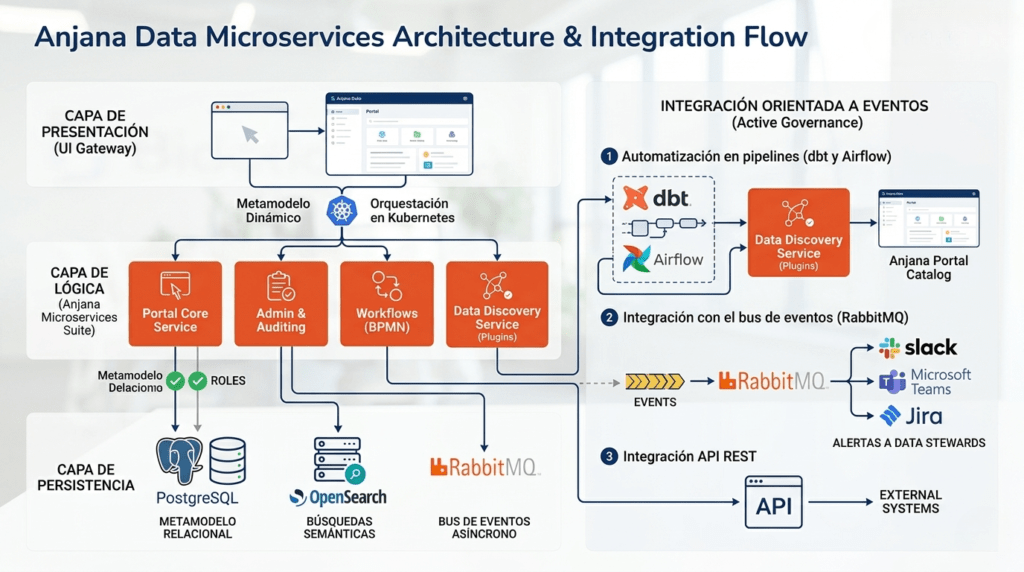
At Bidatia We standardize the technical implementation of Anjana Data, ensuring an optimized and fault-tolerant environment:
Orchestration in Kubernetes
We deploy the suite using Kubernetes manifests (YAML files or Helm Charts personalized). This allows us to isolate critical microservices in their own pods. Besides, we configure horizontal pod autoscalers (HPAs) based on CPU and memory utilization. As a result, we managed to absorb load peaks during massive cataloging processes.
Persistence and search performance
We use PostgreSQL to store the configuration of government structures, roles, and the relational metamodel. In parallel, we implemented Elasticsearch to ensure semantic searches on the portal execute in milliseconds, communicating components asynchronously via RabbitMQ queues.
2. Advanced Configuration in Anjana Data Implementation: The Dynamic Metamodel
El verdadero núcleo de valor de Anjana Data es su dynamic metamodel. While other manufacturers force companies to adapt their glossaries to predefined tables, Anjana allows you to design the governance object structure to the client's specifications from its administration console, without touching a single line of code in the underlying database.
At Bidatia We configured this metamodel by connecting three levels of abstraction:
- Business Objects We define the structure of Glossary Terms, Knowledge Areas, or KPIs, injecting custom attributes for regulatory audits (such as BCBS 239 criticality or GDPR/RGPD privacy indicators).
- Technical Objects We map the physical assets (Tables, Columns, Files, or Kafka Topics) by connecting the platform's automated discovery agents (Data Discovery Plugins).
- Relationships and Validations We design the rules of correspondence between both worlds. This allows for the automatic unification of the business and technical lineage, visually showing how a technical field in a Data Lake directly impacts a financial metric.
3. Event-Oriented Extensibility and Integration (Active Governance)
For data governance to be effective, it must be alive. Anjana Data does not function as a static silo; it exposes a complete corporate REST API and integrates natively into event-driven architectures.Event-Driven Architecture).
Automation in Data Pipelines (dbt and Airflow)
At Bidatia, we develop integrations so that data pipelines automatically notify Anjana Data of any changes in technical structure. By automatically consuming Anjana Data's API, developers can register, document, and validate new assets in real-time. Consequently, this happens during pipeline execution and eliminates any manual intervention.
Integration with the event bus (RabbitMQ)
We configure the platform to publish events in real-time whenever a government milestone occurs (such as the approval of a term or a failure in a quality rule). External tools or corporate messaging systems (Slack, Microsoft Teams, or Jira) subscribe to these RabbitMQ queues to immediately alert the Data Stewards, speeding up response times.
Critical Factors in Anjana Data Projects: The Bidatia Approach
Anjana Data's flexibility is its greatest strength, but it demands methodological rigor during its implementation. In our deployments, we apply two key technical principles:
- Efficient approval circuits: We parameterized the flow engineWorkflow Engineusing standard BPMN notation. We design agile validation circuits that avoid organizational bottlenecks.
- Metamodel Governance: Before creating hundreds of dynamic attributes that saturate the interface, we define a clean metadata taxonomy that simplifies the user experience (UX) for both engineers and business analysts.
Conclusion of Anjana Data Implementation: Agile Government
Anjana Data represents the future of Data Governance: an open, flexible, scalable platform that is completely decoupled vendor lock-in. Its ability to integrate with any technology and automate processes through APIs makes it the ideal choice for organizations seeking agility and real control.
At Bidatia We have the technical and architectural expertise to carry out the deployment, configuration, and advanced integration of Anjana Data into your analytical platform.