

The analytics ecosystem has changed. Organizations with mature engineering teams are no longer looking for ‘paper governance’ based on static inventories. The real challenge of modern architectures (Modern Data Stack) lies in deploy OpenMetadata to integrate governance directly into the data lifecycle (DataOps).
OpenMetadata has consolidated itself as the platform open-source leader to address this need. It doesn't work as an external layer, but as a active metadata layer natively integrated into your data pipelines.
At Bidatia we have designed a Methodological Implementation Framework to deploy it successfully under a technical, automated, and scalable approach.
Bidatia-Style «Active Metadata» Principles
Our methodology breaks with classic bureaucracy and is founded on four pillars:
- Active Metadata The catalog is not populated manually; it self-populates in real-time in response to changes in databases or pipelines.
- DataOps Approach Government is treated as code and integrated into CI/CD workflows.
- Governance in the Pipeline: Quality controls and lineage occur inside of architecture, not in an isolated application.
- From Technical to Business: We built an automated technical foundation before opening the catalog to business users.
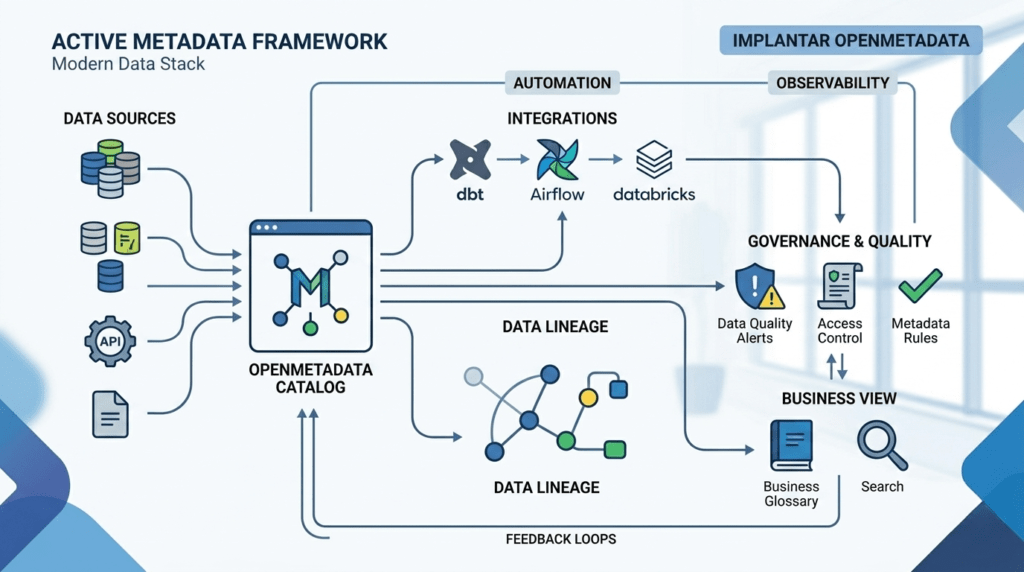
The OpenMetadata Deployment Framework in 6 Phases
Our model prioritizes the robustness of the technical ecosystem from minute one to ensure data reliability before expanding it to the organization.
Phase 1: Architectural Diagnosis and Inventory
We mapped your Stack (Snowflake, BigQuery, dbt, Airflow, Databricks, or Power BI) and we select a technical and limited pilot environment (such as a set of critical analytical models in dbt).
Phase 2: Technical Platform Setup
We are raising the OpenMetadata instance on Kubernetes Using Docker, we configured the metadata database, the search engine (OpenSearch), and the SSO security protocols.
Phase 3: The Technical Pilot (Quick Win)
We activate the Data Lineage (Data Lineage) Automatic. OpenMetadata reads data store queries and dbt/Airflow flows to map how information travels from source to destination.
Phase 4: Active Governance and Automation
We integrate rules of Data Quality connecting the test native to dbt. The catalog immediately alerts the team to schema breaks (schema evolution) o quality failures.
Phase 5: Adoption and Business Glossary
We create the Business Glossary, mapping conceptual terms (like «Active Customer») to governed technical tables to open the platform to business analysts and users.
Phase 6: Scaling and Advanced Observability
We are expanding integrations to environments multi-cloud, we configure access control policies and implement layers of complete observability for proactive anomaly detection.
Critical factors deploy OpenMetadataWhat works and what to avoid?
| What Really Works | What to Avoid |
| Starting with active technical environmentsdbt, Airflow). | Starting a business without a solid technical foundation. |
| Automate lineage extraction from code. | Fill the catalog manually. |
| Integrate quality alerts into the developer's daily workflow. | Over-document thousands of obsolete tables. |
When to choose OpenMetadata over Microsoft Purview?
| Feature / Criterion | Choose OpenMetadata if… | Choose Microsoft Purview if... |
| Technology Ecosystem | You Stack Use Snowflake, Databricks, BigQuery, dbt, or Airflow. | Your infrastructure is heavily tied to Azure, Microsoft Fabric, and Power BI. |
| Team Profile | You have a team of Data Engineers maduro who prioritizes automation. | You are looking for traditional, corporate regulatory compliance. |
| Philosophy | Do you want a platform open-source and avoid the Vendor lock-in. | Do you prefer a native solution integrated into the environment cloud from Microsoft. |
Turn your metadata into a strategic asset
Deploying OpenMetadata means equipping your data infrastructure with a nervous system that monitors lineage and ensures real-time quality.
At Bidatia We are specialists in integrating these modern architectures with a pragmatic and highly efficient approach.