
The data analytics landscape is evolving at a breakneck pace. If you're considering taking the plunge and planning to migration to Microsoft Fabric Having left your old environments behind, you now stand at the threshold of the next major evolutionary leap in corporate analytics.
This is not just a passing trend. The convergence of analytics, data engineering, and artificial intelligence into a single enterprise SaaS platform is the natural direction of the market. The strategic challenge lies in how to transition from Power BI to Fabric without disrupting business operations or overwhelming the IT department.
At Bidatia We have designed this roadmap so that your migration isn’t just a simple change in licenses, but a step toward achieving a true return on investment (ROI) from your information assets.
1. Why switch to Fabric if Power BI already works?
It’s a question that comes up time and again in executive committees. The short answer is simple: Power BI is now a native part of Microsoft Fabric. Fabric does not replace your current reports; rather, it enhances them. While Power BI focuses on the final layer of visualization and semantic modeling, Fabric brings together everything that happens before the data reaches the chart into a single environment:
- Breaking down technical silos: Data engineering (Synapse), integration and pipelines (Data Factory), and data science coexist within the same ecosystem.
- Direct Lake Mode: This is the platform's biggest breakthrough. Your Power BI reports can now access massive amounts of data in the Lakehouse directly and in real time, eliminating the need to schedule endless refresh processes and avoiding the traditional slowness of DirectQuery.
- Unified data governance: Centralize security, object-level access, and regulatory compliance in a single location, reducing the operational burden on the IT team.
2. Roadmap for a Secure Migration to Microsoft Fabric
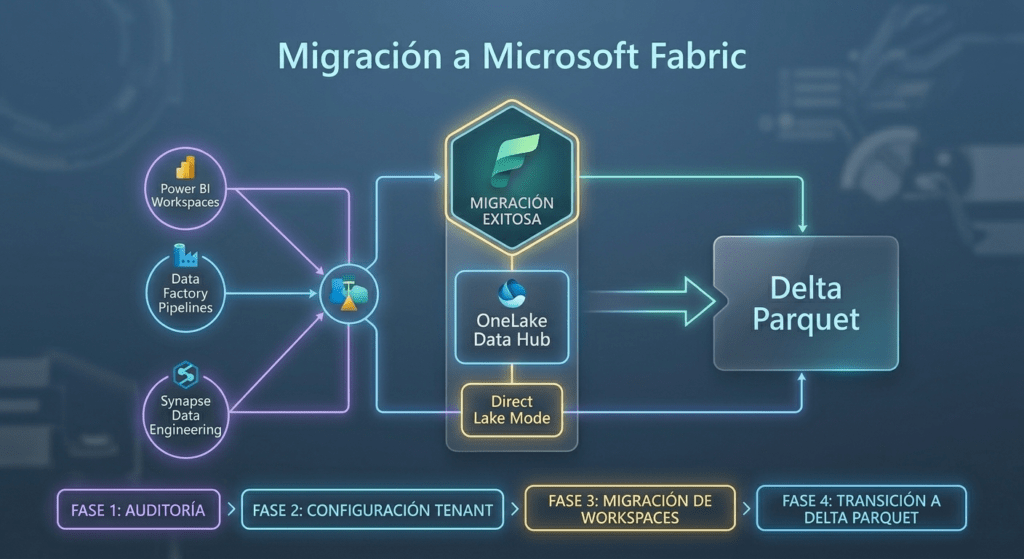
At Bidatia We do not believe in automated mass migrations by default. A successful transition requires a systematic approach and careful planning. We structure the process into four critical phases:
Phase 1: Audit and cleanup of the current environment
Before making any changes, we analyze the status of your Power BI tenant. We identify which reports are actually used on a daily basis and which datasets are duplicated. Migrating outdated data or «noise» only increases storage and processing costs.
Phase 2: Tenant Configuration and Fabric Capabilities
We activate Fabric capabilities by leveraging your existing Premium licenses or assigning new F capabilities. In this phase, we design the architecture OneLake, your organization's single, centralized data repository.
Phase 3: Native Workspaces Migration
Taking advantage of the native compatibility of Microsoft tools, we reassigned the workspaces (WorkspacesWith Power BI to the new Fabric capacity. This ensures your reports remain operational for business users while we optimize the underlying infrastructure layers.
Phase 4: Transition to Delta Parquet storage
To unlock Fabric’s full potential, we’re gradually migrating traditional data sources to Delta tables in OneLake. This is the key step that allows your reports to benefit from the speed of Direct Lake.
3. The 3 Most Common Mistakes When Adopting Fabric
No matter how well-integrated the Microsoft suite may be, migrating to a new architecture always presents organizational challenges. In our implementations, we address three common pitfalls:
- Think of Fabric as «the new Power BI»: Using Fabric solely to create visual graphics is a waste of your investment. To achieve a true ROI, you need to train your team in engineering skills and advanced data analytics.
- Ignore Capacity Unit (CU) optimization: Fabric's capabilities are billed based on compute power usage. Poorly optimized DAX queries or data loads can drive up your monthly bill. In Bidatia We monitor and adjust resource usage from the very start.
- Lack of change management: Adopting a unified platform alters traditional workflows for analysts and engineers. Technical support and hands-on training are indispensable for project success.
Conclusion: The Foundation for Artificial Intelligence
Migrating to Microsoft Fabric reduces the time-to-market in report preparation, democratizes access to secure data across departments, and prepares your company for the implementation of advanced tools such as Copilot, allowing you to interact with your corporate data using natural language in a secure manner.
At Bidatia We will evaluate your current Power BI infrastructure and design a tailored migration plan, minimizing technical risks and maximizing the economic performance of your cloud investment.